
What We Study
Although typically mischaracterized as rare, eating disorders are relatively common and have the second-highest mortality rate among mental disorders. Unfortunately, many people do not achieve remission and sustain recovery from their eating disorder – even with high quality, evidence-based treatment – thus, it is critical to continue to improve our treatments and get them to the people who need them.
Our research addresses two basic questions for improving eating disorder care:
1) What are promising new treatment targets that could be integrated with existing therapies to enhance results for clients and their families?
We are conducting translational research identifying potentially modifiable mechanisms, such as sleep, food security, and relationships, that contribute to eating disorder psychopathology.
2) How can we make empirically supported treatments for eating disorders more accessible to all who need them?
We are developing mobile-based treatments for eating disorders that have the potential to increase treatment efficacy and expand access to evidence-based care.
________________________________________________________________________________________________________________
Are you interested in participating in research on eating behaviors at UNLV?
Sign up for the Clinic for Research on Eating, Sleep, and Therapy’s (CREST) participant
repository to be notified if you may be eligible for future research studies. You will complete a
brief screening on eating behaviors and provide your contact information. To learn more, please
click on this link.
CREST-LED STUDIES
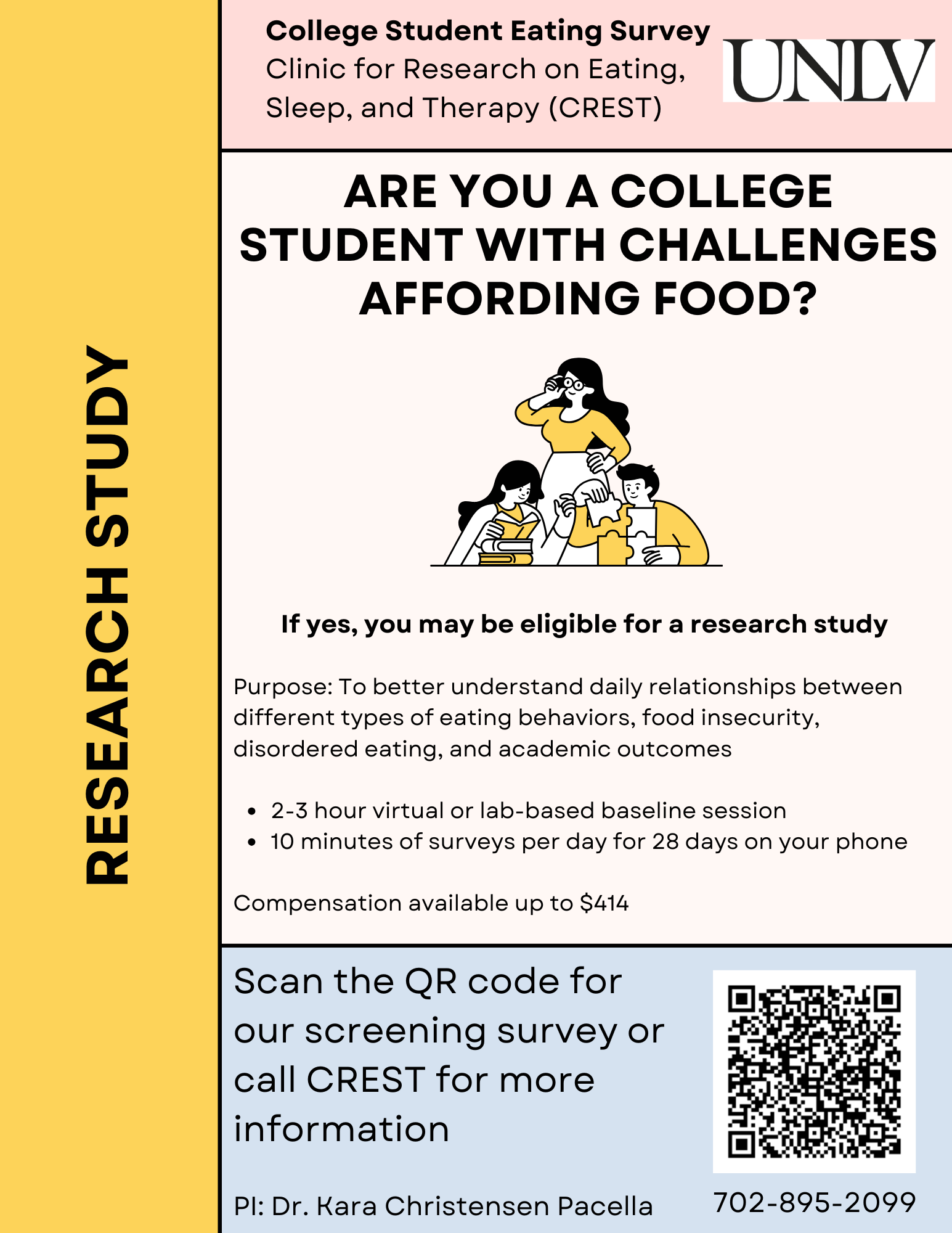
College Student Eating Survey
Food insecurity is a common concern on college campuses and impacts many people’s health and academic performance; however, we do not know enough about daily experiences of students with food insecurity. This study, funded by National Institutes for General Medical Sciences, will help us learn more about daily relationships between different types of eating behaviors, food insecurity, disordered eating, and academic outcomes.
Interested in participating? Complete our screener here or call CREST at 702-895-82099.
Funding: National Institutes for General Medical Sciences
Regular Eating and Sleep Treatment Pilot Study
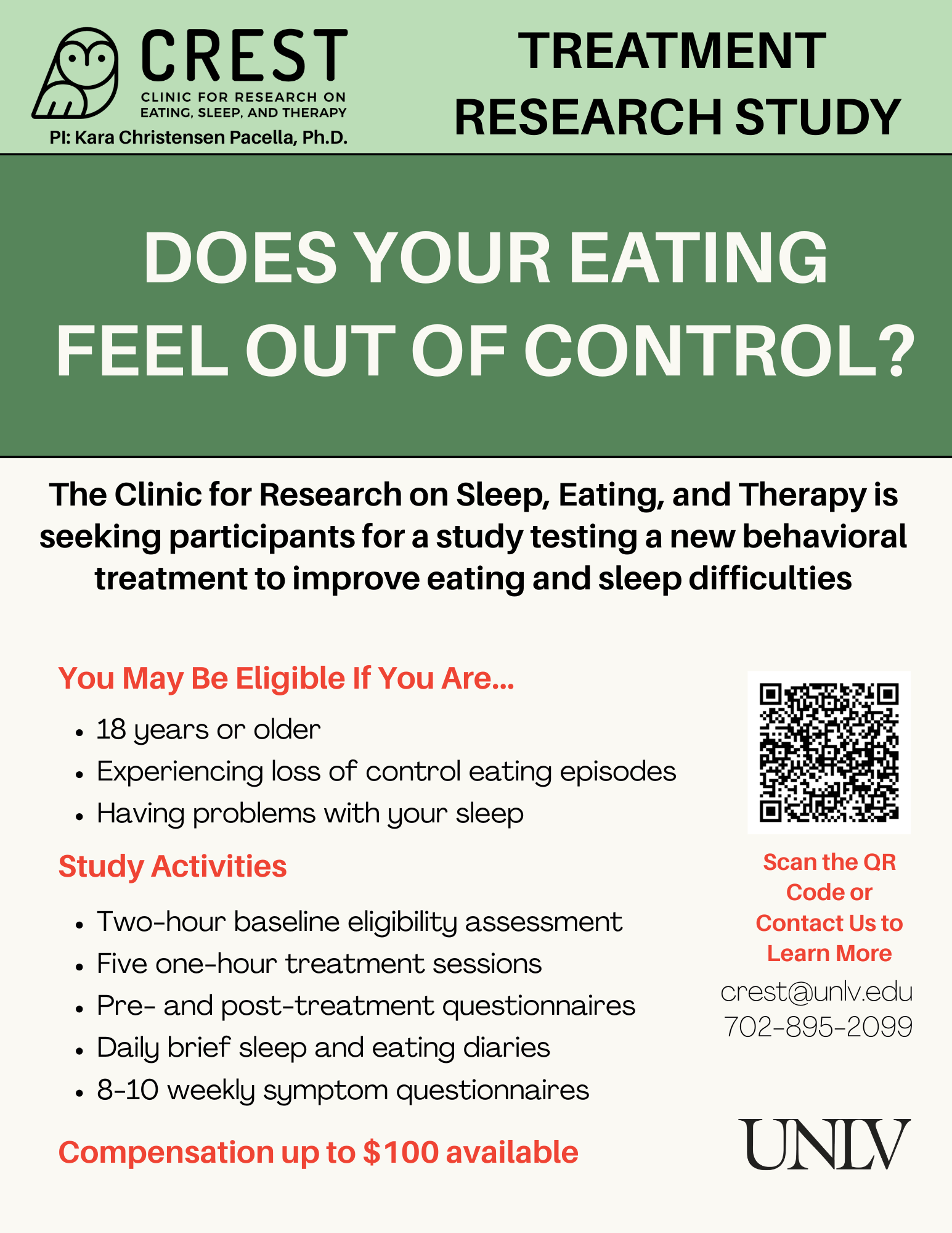
The Clinic for Research on Eating, Sleep, and Therapy at University of Nevada Las Vegas (PI: Dr. Kara Christensen Pacella) is recruiting participants for a study testing a new behavioral treatment for people with eating and sleep difficulties. Individuals who are 18 years or older and experiencing loss of control eating and problems with their sleep are invited to complete our screening questionnaire. In this treatment, participants meet weekly with a therapist to make changes to their eating, sleep, and activity schedules to better align their circadian rhythms. Study participation consists of one baseline visit, three-to-five weeks of baseline surveys, five treatment sessions, pre- and post-treatment questionnaires, daily brief sleep and eating diaries, and weekly symptom questionnaires. Participants may receive up to $100 for completing study surveys. This study is minimal risk, although some participants may experience daytime sleepiness when adjusting their sleep schedules.
Interested in participating? Complete our screener here.
Pilot Study of Nightmare Treatment for People with Disordered Eating
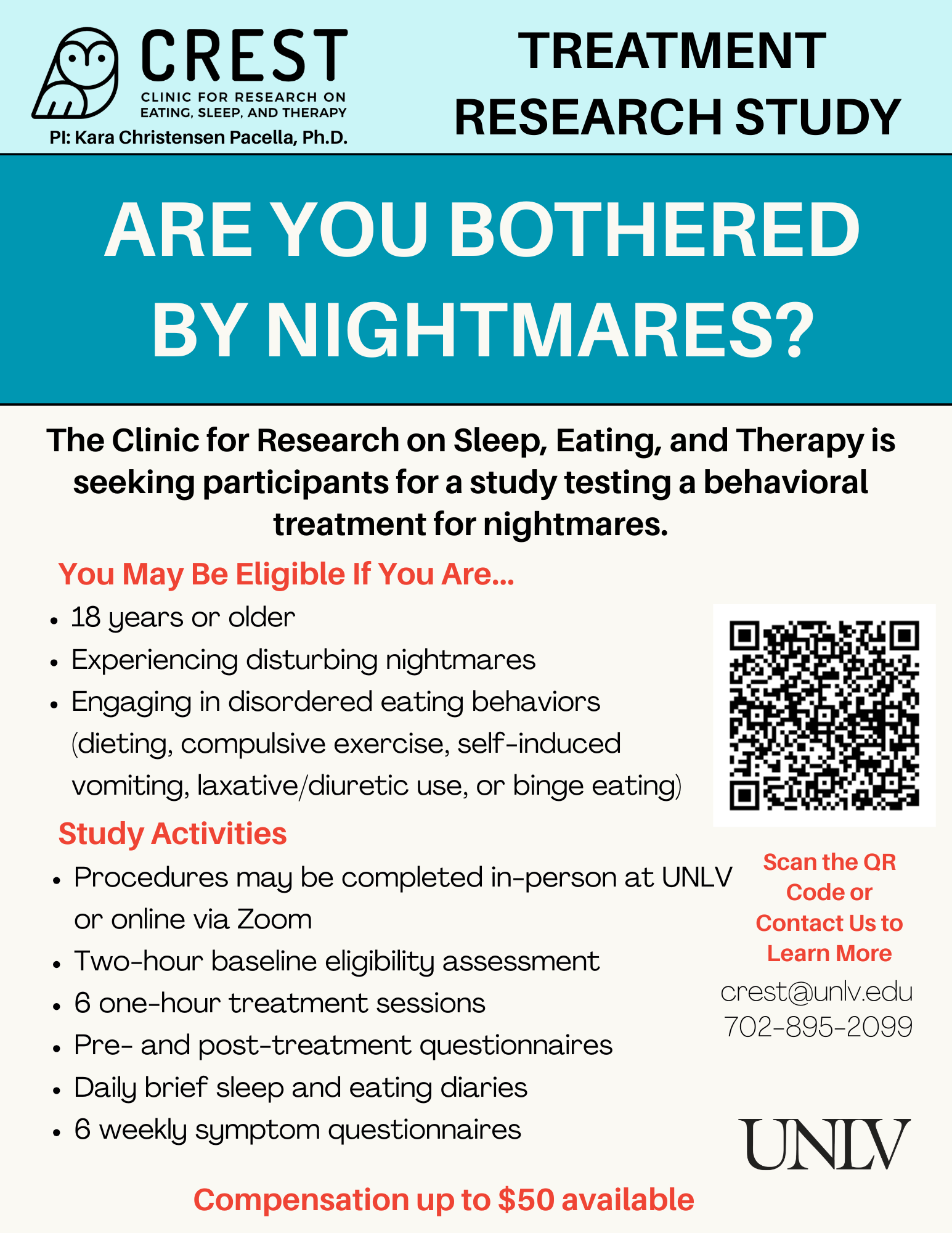
The Clinic for Research on Eating, Sleep, and Therapy at University of Nevada Las Vegas (PI: Dr. Kara Christensen Pacella) is recruiting participants for a study testing the efficacy of Cognitive Behavioral Therapy for Nightmares (CBT-N) among people who have nightmares and disordered eating. CBT-N is a recommended first line treatment for nightmares according to leading sleep health organizations. Individuals who are 18 years or older and experiencing disturbing nightmares and disordered eating behaviors (i.e., dieting, compulsive exercise, self-induced vomiting, laxative/diuretic use, or binge eating) are invited to complete our screening questionnaire. Participants will be randomized to receive CBT-N immediately or after a delay of 6 weeks. Study participation consists of one baseline visit, six treatment sessions, pre- and post-treatment questionnaires, daily brief sleep and eating diaries, and weekly symptom questionnaires. Study procedures may be completed in person on the UNLV campus or online via Zoom. Participants may receive up to $50 for completing study surveys. This study is minimal risk, although some participants may experience daytime sleepiness when adjusting their sleep schedules.
Interested in participating? Complete our screener here.
Thoughts about Self and Emotions Study
This study explores links between different types of emotion regulation strategies and body dissatisfaction. In Part 1 of the study, participants complete surveys on emotion regulation, mental health symptoms, and disordered eating behaviors. A subset of participants will be invited to complete Part 2, which is a lab-based protocol asking participants to practice using different types of emotion regulation strategies and report their emotional responses.
Project lead: Maegan Nation
CLOSED CREST STUDIES
Protective factors of eating pathology
Project lead: Hoor Ul Ain
Eating Behaviors, Family Dynamics, and Acculturation in College Students.
Project leads: CREST undergraduate research assistants collaborative project
Relationship Satisfaction, Emotion and Behavior Study
Project lead: Maegan Nation
Characterizing thoughts related to sleep and eating behaviors
Collaborators: Leah Irish (North Dakota State University), Angeline Bottera (University of Kansas), Kyle De Young (Wyoming)
Healthcare Experiences Survey
Project lead: Shannon Sagert
Honors student: Melanie Garcia
McNair Summer Institute student: Isabella Aceituno
Eating Behaviors During Ramadan
Main Findings: Women with elevated disordered eating symptoms prior to Ramadan experienced decreases in loss of control eating, general disordered eating problems, and anxiety during Ramadan. It is possible that observing Ramadan may involve protective factors that buffer against disordered eating symptoms and improve mental health.
Published in International Journal of Eating Disorders (Ain & Christensen Pacella, 2026)
Project lead: Hoor Ul Ain
Smart Technology for Anorexia Nervosa Recovery: A Pilot Intervention for the Post-Acute Treatment of Anorexia Nervosa
Funding: National Institute of Mental Health
COLLABORATIVE PROJECTS
Building Healthy Eating and Self-Esteem Together for University Students (BEST-U): A Pilot Randomized Controlled Trial of an mHealth Intervention for Binge-Spectrum Disorders
BEST-U is a new mobile-based treatment for university students with disordered eating that was developed by researchers at University of Kansas, Children’s Mercy Hospital, and University of Nevada, Las Vegas. BEST-U uses an interactive app supplemented with telehealth coaching to help students reduce their engagement in unhelpful eating behaviors and increase their quality of life. Initial results from our clinical trial have been highly promising– many students reported decreased disordered eating symptoms and less interference from problematic eating behaviors! We recently received a $715,000 grant from the National Institute of Mental Health to test BEST-U at the University of Kansas Student Health Center. As part of this project, we are also conducting focus groups with UNLV’s Student Health Center to help develop our provider training for BEST-U and learn more about how we can expand BEST-U to other institutions.
Learn more about our study here.
PIs: Kara Christensen Pacella and Kelsie Forbush (University of Kansas)
Funding: National Institutes of Mental Health
Assessment of eating disorder and comorbidity risk and resilience in a nationally representative sample of recent military enlistees
The purpose of this study is to evaluate a screener (Brief Assessment of Stress and Eating (BASE)) to identify military service members who may have an eating, mood, anxiety, or trauma-related disorder compared to existing screeners; 2) identify general and military-specific factors that predict (or protect from) the development of an eating disorder in military service members in their first three years of service; 3) assess longitudinal course and patterns of comorbidity between eating disorders and internalizing and externalizing psychopathology in military members with eating disorders in their first three years of service.
PI: Kelsie Forbush (University of Kansas)
Funding: Department of Defense
